In the heart of every culture, there is a thread—a story woven into fabric that tells of triumphs, struggles, and the enduring power of human hands. For Syria, that thread is spun from pure silk and precious metal. This is the story of Damascus brocade, a textile that is not merely woven but built, thread by thread, into a resilient archive of a nation’s identity. It is a legacy we at Rania Kinge have dedicated ourselves to preserving, a craft that empowers the women who refuse to let its intricate beauty disappear.
Discover the profound history, intricate artistry, and resilient future of Damascus brocade—a textile that carries the weight of history and the promise of a dignified future.
Defining the Majesty of Damascus Brocade
At its essence, Damascus Brocade is a heavy, richly decorative shuttle-woven fabric, often made of colored silk and sometimes enriched with gold or silver threads. Its defining characteristic is a raised, figured pattern that appears embossed against the ground weave. This is where its regal moniker, the "Queen of Fabrics," originates—a title earned through centuries of adorning royalty, gracing ceremonial halls, and capturing the imagination of traders along the Silk Road.
But to truly understand its soul, one must distinguish it from its more common cousin, damask. While both originate from Damascus, damask is typically a monochrome, reversible fabric where the pattern is formed by the contrast of satin and sateen weaves. Brocade, however, is a far more complex art. It involves multiple colors and supplementary weft threads that create an intricate, non-reversible design, giving the fabric its signature weight, depth, and opulent texture. It is a textile that demands to be seen, touched, and understood.
In the lexicon of Syrian textiles, one also encounters "Aghabani," a beautiful craft of hand-guided machine embroidery on silk or cotton. While distinct from the loom-woven patterns of brocade, it shares a common heritage of Damascene artistry and is another vital thread in the rich tapestry of Syrian craft we strive to honor.
The Origins: From the Umayyad Caliphate to Global Royalty
The story of Damascus brocade begins in the city that gave it its name. During the Umayyad Caliphate in the 7th century, Damascus became a global center for textile innovation. Weavers, benefiting from the city's strategic position on the Silk Road, blended Byzantine, Persian, and Chinese techniques to create a fabric of unparalleled complexity and beauty. This was not just cloth; it was a currency of power, a symbol of status, and a canvas for artistic expression.
Its legendary status was cemented in the 20th century. One of its most famous appearances was in 1947, when it was chosen for the wedding dress of then-Princess Elizabeth of England, a gift from the Syrian state that showcased the craft on a global stage. This moment encapsulated the fabric's journey from an ancient trade good to a symbol of international diplomacy and timeless elegance. The patterns that traveled the Silk Road centuries ago found their way into the halls of modern royalty, proving the enduring appeal of this masterful craft.
The Cultural Symbolism of the Patterns
To look at a piece of Damascus brocade is to read a story. Every pattern is a chapter, every thread a word. The motifs are not random decorations; they are a visual language steeped in Syrian geography, folklore, and history. Traditional designs like the "Damascene Rose" (Al-warda al-shamiyya) evoke the fragrant gardens of the city, while geometric patterns like "Al-Salahi" echo the intricate tilework of its ancient mosques and palaces.
Other motifs might depict pairs of birds, symbolizing love and loyalty, or patterns representing pomegranates and grapes, signifying fertility and abundance. In every lustrous inch of fabric, there is a deliberate narrative, a connection to the land and its people. This is the dignity of the weaver made manifest: the ability to encode generations of cultural memory into a tangible, beautiful form that can be passed down through time.
The Alchemical Process: From Silk Thread to Golden Patterns
The creation of Damascus brocade is less a manufacturing process and more a form of alchemy. It is a slow, deliberate ritual that transforms raw materials into a textile masterpiece. The core ingredients are natural silk, prized for its unparalleled luster and strength, and threads of genuine gold or silver. In our work at Rania Kinge, we witness firsthand the reverence with which our artisan partners handle these materials, knowing they are the lifeblood of their heritage.
The process is intensely physical. A master weaver, operating a manual jacquard loom, can produce only a few centimeters of this intricate fabric per day. The air is filled with the rhythmic clatter of the shuttle and the gentle hum of the loom—a sound that has echoed through Damascene workshops for centuries. The weight of the finished silk in one's hands feels substantial, cool, and alive with the energy of its creator. It is a sensory experience that no machine can replicate.
The Jacquard Loom: A Mechanical Masterpiece
The traditional tool for weaving Damascus brocade is the manual jacquard loom, a marvel of early mechanical engineering. This loom uses a system of punched cards to control the lifting of individual warp threads, allowing for the creation of incredibly complex and non-repeating designs. It is the original form of mechanical data storage, a precursor to modern computing.
Operating it requires immense skill and coordination. The weaver’s hands and feet move in a constant, synchronized dance, managing hundreds, sometimes thousands, of threads simultaneously. This slow-craft methodology stands in stark contrast to the industrial looms of fast fashion, which prioritize speed and volume over artistry and soul. The jacquard loom ensures that every piece is a direct result of human intention and skill, a testament to patience and precision.
Materials of Resilience: Silk, Gold, and Silver
The choice of materials is non-negotiable. One hundred percent natural silk is essential for achieving the fabric’s signature sheen and drape. Unlike synthetic fibers, silk breathes, regulates temperature, and interacts with light in a way that gives the brocade its living, shimmering quality. It is a material as resilient as it is beautiful.
The metallic threads are created through a meticulous process where thin silk threads are carefully wrapped in foils of real gold or silver. This not only imparts a regal brilliance but also adds to the fabric's durability and weight. These noble materials ensure that a garment made from Damascus brocade is not a fleeting trend but an heirloom, designed to last for generations and carry its stories into the future.
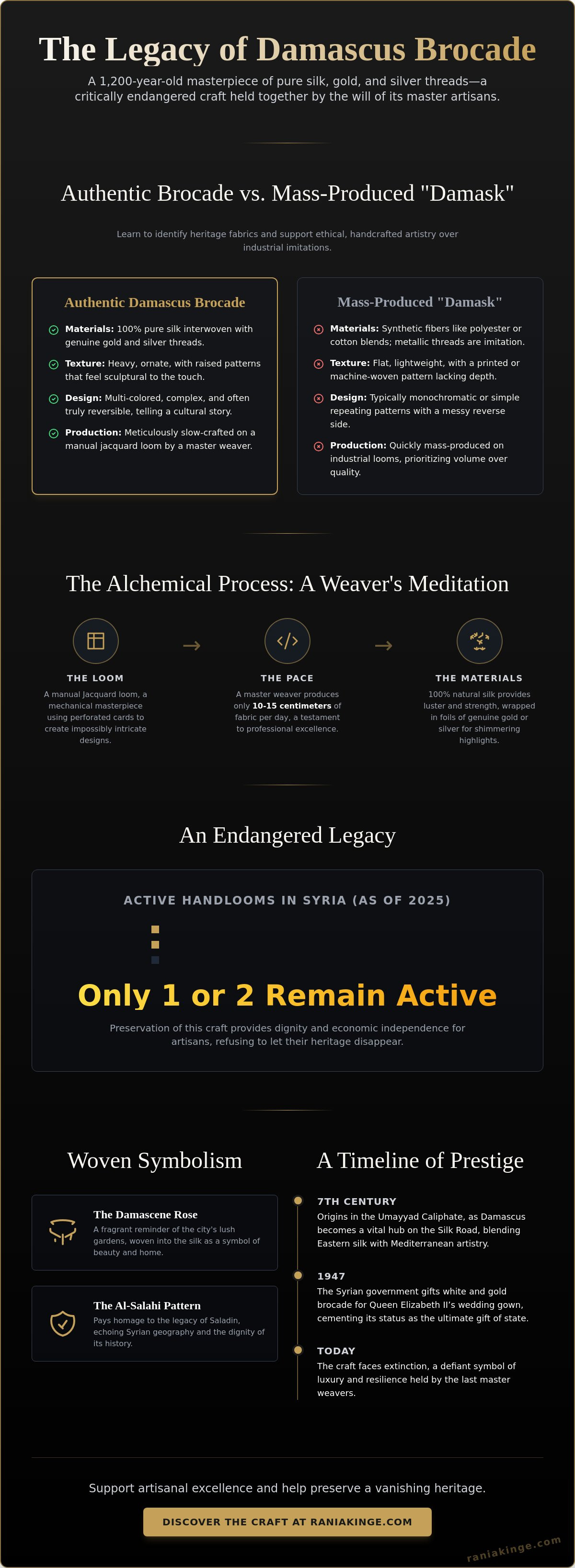
Authenticity in a World of Imitations: Real Brocade vs. Damask
In today's global market, the lines between authentic craft and mass-produced imitation have become blurred. This is the challenge we confront daily. Consumers are often sold synthetic "Damascus Damask" or "Brocade Style" fabrics, typically made in China or Spain, which bear little resemblance to the genuine article. At Rania Kinge, we believe that understanding the difference is an act of cultural preservation.
Authentic Syrian brocade can be identified by several key characteristics. The feel is unmistakable: it is heavy, dense, and cool to the touch due to the silk and metal content. It reflects light with a deep, complex luster, unlike the flat, artificial shine of polyester. Most importantly, the reverse side of the fabric will show the "floats"—the long, uncut supplementary weft threads that create the pattern on the front. Choosing true, handcrafted brocade is an ethical decision, a vote against the dilution of heritage and in favor of the artisans who are its rightful custodians.
| Feature | Authentic Damascus Brocade | Mass-Produced "Damask Style" Fabric |
|---|---|---|
| Material | 100% natural silk, often with real gold or silver threads. | Polyester, rayon, cotton blends, or other synthetic fibers. |
| Weave | Multi-colored, non-reversible pattern with a raised texture. | Often a single-color, reversible damask weave or a printed pattern. |
| Feel & Weight | Heavy, dense, and cool to the touch with a fluid drape. | Lightweight, often stiff, and can feel synthetic or plastic-like. |
| Luster | Deep, multi-tonal sheen that changes with the light. | A flat, uniform, or overly shiny plastic-like gloss. |
| Origin | Handwoven on jacquard looms, traditionally in Damascus, Syria. | Industrially produced in factories worldwide (e.g., Spain, China). |
| Ethical Impact | Supports master artisans and preserves an endangered cultural heritage. | Often part of the fast-fashion system with opaque supply chains. |
The Synthetic Trap: Why Polyester Cannot Compete
Polyester and other synthetic fibers are the antithesis of what makes brocade special. While they can mimic the patterns, they fail to replicate the soul of the fabric. Natural silk is breathable and thermoregulating, making it comfortable to wear in various climates. Synthetics trap heat and moisture, feeling clammy and uncomfortable against the skin.
Over time, the difference becomes even more stark. Synthetic fibers degrade, pill, and lose their artificial sheen, often ending up in landfills. The natural dyes traditionally used in silk production have a lower environmental impact than the harsh chemical dyes required for polyester. Authentic brocade, with its durable, natural fibers, is an investment in quality that endures.
Geographic Authenticity: The Spirit of Damascus
The "Damascus" in Damascus brocade is not just a name; it is a mark of provenance. Historically, the specific climate and mineral-rich water of the Barada river in Damascus were believed to be crucial for processing the silk, giving it a unique softness and strength. While the craft has been displaced by conflict, its spirit remains tied to its city of origin.
This is the essence of our work at Rania Kinge. We ensure that the spirit of Damascus travels with the artisans who have been forced to leave their homes. By providing them with the means to continue their craft in a new context, from our base in Geneva, we help preserve the techniques, the patterns, and the cultural memory embedded in every thread. The label may say "Geneva," but the soul of the fabric remains defiantly Damascene.
Damascus Brocade in Modern Fashion: A Timeless Statement
For too long, Damascus brocade has been viewed as a museum piece or a fabric reserved for upholstery and formal wear. We see it differently. We believe its bold textures, rich history, and inherent durability make it a powerful material for contemporary luxury fashion. It is a statement of substance in a world of fleeting trends.
The key to incorporating brocade into a modern wardrobe is balance. Its opulence and weight demand thoughtful styling. A structured brocade piece can be the focal point of an outfit, transforming a simple silhouette into a work of art. Its resilience also makes it surprisingly practical for modern, active lifestyles—this is not a fragile fabric meant to be kept under glass.
From Runway to Street: Styling the Statement Piece
At Rania Kinge, we design pieces that bridge the gap between ancient craft and modern utility. Imagine a handcrafted Siano bag, its panels of shimmering brocade telling a story of heritage while its clean, contemporary lines make it the perfect accessory for a business meeting or an evening out. The juxtaposition is where the magic lies.
Pairing a bold brocade accessory with a minimalist ensemble, like our understated Gigi top, creates a look that is both sophisticated and grounded. This is the concept of "heirloom fashion"—investing in pieces that are not defined by a season but by their story and craftsmanship. They are designed to be worn, loved, and eventually passed on, carrying their legacy forward.
The Ethics of Luxury: Why Brocade is Sustainable
True luxury is sustainable. In an era of disposable fashion, Damascus brocade represents a more conscious way of thinking about our clothing. When you consider the "Cost-per-Wear" of a fabric designed to last for 50 years or more, its initial investment is put into perspective. It is the ultimate form of slow fashion.
Artisanal production, by its very nature, minimizes waste. Unlike massive factory runs that result in tons of deadstock fabric, our weavers produce what is needed, valuing every inch of their precious material. This is social sustainability in action: supporting the economic independence of weaver communities ensures that their skills, and the culture they represent, survive and thrive.
Weaving Resilience: How Rania Kinge Preserves a Vanishing Heritage
Rania Kinge was founded in 2014 with a clear mission: to create a bridge between the extraordinary skill of displaced Syrian artisans and a global market that values authenticity and ethical production. We are a social enterprise built on a model of "Dignity over Charity." We do not see our artisan partners as victims to be pitied, but as professional craftswomen whose talent deserves a platform and fair compensation.
From our atelier in Geneva, we work to provide these women with the resources, design direction, and market access they need to rebuild their lives and preserve their cultural identity. Every purchase of a Rania Kinge piece directly contributes to this mission. It is a tangible investment in female empowerment, cultural preservation, and the belief that beauty can be a powerful act of resistance and resilience.
The Hands Behind the Loom: Stories of Empowerment
Behind every shimmering pattern is a woman with a story. A woman who may have lost her home, but not her skill. A woman who, through the familiar rhythm of the loom, finds not only a source of income but also a connection to her heritage and a sense of purpose. For many, the act of weaving is a form of therapy, a way to process trauma and create order and beauty amidst chaos.
This craft provides a profound sense of agency and economic independence. It allows women to support their families on their own terms, using a skill that has been passed down through generations. Preserving one's culture while in displacement is not a luxury; it is a psychological necessity. It is a way of saying, "We are still here. Our story continues."
Your Purchase as an Act of Advocacy
When you choose a piece from our collection, you are doing more than acquiring a beautiful object. You are becoming part of a story of survival and revival. Each Dweir bag or brocade-accented garment is a signature of transparency, a testament to a supply chain that is short, ethical, and human-centered. You know who made your piece and the heritage it represents.
This is the ripple effect of conscious, ethical shopping. It sends a clear message that there is a market for heritage crafts and that the stories of marginalized communities matter. It is an act of advocacy that helps ensure these irreplaceable skills do not become a footnote in history books. Your support allows us to continue weaving beauty from struggle, one resilient thread at a time.
Discover the collection that weaves beauty from struggle at raniakinge.com
Frequently Asked Questions
- What is the difference between Damascus brocade and damask?
- The primary difference is in the weaving technique and complexity. Damask is a reversible, single-color fabric where the pattern is created by contrasting satin and sateen weaves. Damascus brocade is a non-reversible, multi-colored fabric with a raised pattern created by supplementary weft threads, making it heavier and more ornate.
- Is Damascus brocade made of real silk?
- Yes, authentic Damascus brocade is traditionally woven from 100% natural silk. High-end versions are often embellished with threads wrapped in genuine gold or silver, which contributes to their signature luster, weight, and value.
- How do I care for and clean Damascus brocade garments?
- Due to the delicate nature of the silk and metallic threads, it is strongly recommended to have Damascus brocade pieces professionally dry-cleaned by a specialist experienced with couture or heritage fabrics. Avoid machine washing and direct, high heat when ironing.
- Why is Damascus brocade considered an endangered craft?
- The craft is endangered due to several factors: the conflict in Syria, which has displaced artisans and destroyed workshops; the rise of cheap, industrial imitations that devalue the authentic product; and the time-intensive nature of the skill, which makes it difficult for younger generations to learn.
- Can I wear Damascus brocade in the summer?
- While it is a heavy fabric, its natural silk fibers are highly breathable. Lighter brocade pieces, such as vests, accessories, or panels on a garment, can be comfortably worn in warmer weather. It's more versatile than its weight might suggest.
- How can I tell if my brocade is ethically sourced?
- The best way is to buy from transparent brands that work directly with artisans. At Rania Kinge, we champion a "Dignity over Charity" model, ensuring our artisan partners are paid fairly and their work is honored. Ethical sourcing means knowing the story behind the product and the people who made it.
- What makes Syrian silk superior to other varieties?
- Historically, Syrian silk was renowned for its quality, which was attributed to the local sericulture (silkworm cultivation) and the unique properties of the water used in processing. While much raw silk is now imported, the superior quality of the final brocade comes from the unparalleled skill of the Syrian weavers.
- Does Rania Kinge use authentic Syrian brocade in their designs?
- Absolutely. Our mission is centered on preserving this exact craft. We exclusively use authentic, handcrafted Damascus brocade woven by the displaced Syrian women we partner with, ensuring every piece is a genuine testament to this resilient heritage.