In a workshop where electricity is a luxury and the hum of a generator provides the only rhythm, a woman named Mariam stitches the leather of a Siano bag with unwavering precision. Her hands don't ask for pity; they demand respect for a craft perfected under the weight of displacement. You've likely felt the confusion of sorting through labels like "vegan leather" while wondering if the hands that made your ethical handbags were treated with the dignity they deserve. It's a common fear that beneath a beautiful exterior lies a story of exploitation you never intended to support.
We agree that luxury should never be a mask for hardship. This guide provides a clear framework to help you identify truly conscious pieces that prioritize artisan resilience and transparent craftsmanship over clever marketing. We'll look at how the 2026 EU Digital Product Passport and new deforestation regulations are finally bringing accountability to the runway. You'll discover how to find high-design statement pieces that connect you directly to the strength of the person who made them, ensuring your style reflects your deepest values.
Key Takeaways
- Learn to distinguish between marketing buzzwords and the raw, humanitarian urgency that defines a truly ethical accessory.
- Discover why professional excellence, not charity, is the most powerful tool for restoring dignity to displaced artisans.
- Uncover the truth about material sourcing to avoid the "vegan leather" trap and find alternatives that respect both people and planet.
- Apply a conscious collector's checklist to identify ethical handbags that represent your personal "ethical north star".
- Explore how high-design pieces like the Dweir and Siano bags act as a bridge between marginalized communities and international luxury.
Beyond the Label: What Defines a Truly Ethical Handbag?
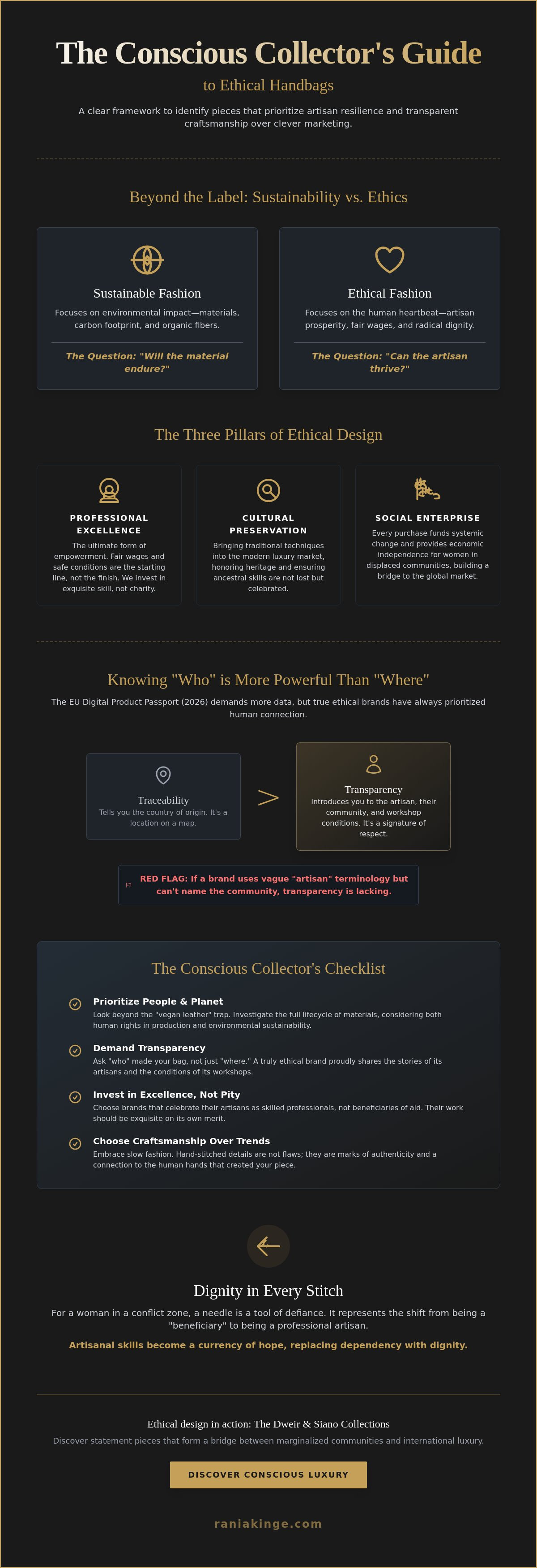
Luxury is not a price point. It's a promise of integrity. For too long, the global fashion industry has hidden behind the opaque veil of the "made in" label, obscuring the human cost of a beautiful silhouette. In 2026, the definition of ethical handbags has evolved beyond simple environmental metrics to include the radical notion of human dignity. It's an intersection where the health of our planet meets the prosperity and professional excellence of the person behind the needle.
While Sustainable fashion often focuses on organic fibers or carbon footprints, ethical fashion focuses on the heartbeat. Sustainability asks if the material will endure. Ethics asks if the artisan can thrive. Truly ethical accessories challenge the exploitative cycles of fast fashion by replacing disposable trends with timeless craftsmanship that honors the maker's life. This shift moves us away from a culture of consumption toward a culture of connection.
The Three Pillars of Ethical Accessory Design
Professional excellence is the ultimate form of empowerment. Fair wages and safe conditions are merely the starting line, not the finish. A truly ethical model prioritizes cultural preservation by bringing traditional techniques into the modern luxury market. It operates as a social enterprise, where every purchase funds systemic change and provides economic independence for women who have known only displacement. It's about building a bridge between a refugee workshop and an international runway.
Transparency vs. Traceability: Knowing Your Artisan
Knowing "who" made your bag is infinitely more powerful than knowing "where." Traceability tells you the country of origin, but transparency introduces you to the woman herself. With the implementation of the EU Digital Product Passport in 2026, brands are now required to provide detailed data on a product's lifecycle. However, technology is only a tool. The real signature of an ethical brand is the refusal to hide behind vague "artisan" terminology. If a brand cannot name the community or describe the workshop conditions, it's a red flag. Transparency is a signature of respect, ensuring that the women behind the Dweir bag or the Siano bag are seen, heard, and honored for their skill. We don't just sell a product; we advocate for the resilience of the hands that shaped it.
Artisan Resilience: The Human Heart of Ethical Fashion
A stitch is more than a thread. It's a lifeline. Discussing ethical handbags is about more than leather or labor laws; it's about the restoration of a human soul. For a woman in a conflict zone, a needle is a tool of defiance. It represents the shift from being a "beneficiary" of aid to being a professional artisan. This is the core of our mission. Dignity replaces dependency. Strength replaces pity.
Aligning with the core principles of sustainable fashion requires us to look past the materials and into the eyes of the maker. We don't ask you to buy because you feel sorry for the woman behind the bag. We ask you to buy because her work is exquisite. This is how we bridge the gap between marginalized communities and the global market. Professional excellence is the most potent form of social activism.
Empowering Displaced Women Through Craft
Displacement often strips people of their identity, leaving them as statistics in a report. Stable, dignified work gives that identity back. In workshops where the sound of the city is often the sound of struggle, the focused silence of craftsmanship creates a sanctuary. These women aren't just survivors; they're experts in their field. Their resilience is woven into every seam. By choosing ethical handbags that prioritize human resilience, you fund a movement of economic independence. It's a bridge between conflict and commerce, where artisanal skills become a currency of hope and a means to rebuild a life from the ground up.
The Artisanship Definition: Why the Human Touch Matters
Mass production is cold. It lacks a pulse. Small-batch production ensures that every piece receives the attention it deserves, moving at the intentional pace of slow fashion. In the world of high-end design, the slight variations of a hand-stitched handle aren't flaws. They're marks of authenticity. These "imperfections" tell you that a person, not a machine, spent hours perfecting your accessory. This approach reduces waste while increasing the exclusivity of your piece. When you carry a bag born from such intensity, you carry a story of survival. You can explore our latest handcrafted collections to see how this vision of dignity comes to life in every design.
Navigating the Greenwashing Maze: Materials vs. Human Rights
Marketing is a loud room. Integrity is a quiet action. When searching for ethical handbags, you're often met with a barrage of "eco-friendly" claims that prioritize optics over substance. The most pervasive illusion is the "vegan leather" trap. While the name suggests a kindness to the earth, the reality is often a petrochemical byproduct like Polyurethane (PU) or Polyvinyl Chloride (PVC). These plastic-based synthetics don't breathe, they don't age, and they don't support the artisan. They simply persist in landfills for centuries. Choosing a plastic bag because it’s labeled "vegan" often ignores the toxic manufacturing processes that poison the water and air of the very communities we seek to empower.
True luxury requires a deeper evaluation of material integrity. We must look toward high-quality leather sourced from local agricultural markets or innovative bio-based alternatives that don't rely on fossil fuels. Longevity is the ultimate sustainability metric. A bag that is designed to last twenty years is infinitely more ethical than three "sustainable" bags that fall apart in twenty months. When a piece is handcrafted with resilience, its durability becomes a testament to the skill of the woman who stitched it. We prioritize materials that respect the earth without sacrificing the human dignity of the maker.
Material Breakdown: The Ethics of What We Carry
Sustainable leather isn't an oxymoron; it's a commitment to a circular economy. By sourcing leather from local agricultural markets, we ensure that no part of the animal is wasted while supporting regional farmers. Traditional textiles like silk and hand-woven brocade offer a path to cultural preservation, keeping ancient techniques alive in a modern market. Additionally, using recycled components gives new life to discarded luxury, proving that beauty doesn't always require new extraction. These materials carry a weight of history and a promise of professional excellence.
Spotting Greenwashing in Handbag Marketing
Greenwashing is the hollow space between a brand’s glossy marketing campaign and the unvarnished reality of its production line. To avoid this maze, you must look past vague terms like "conscious" or "natural," which have no legal definition. Instead, seek out third-party certifications like the Leather Working Group (LWG) or B Corp status. As we move toward 2027, the EU Digital Product Passport will make this transparency mandatory, but you don't have to wait. Demand to see the workshop. Ask for the names of the artisans. If a brand hides behind a curtain of "proprietary information," they're likely hiding a lack of accountability. Transparency isn't a marketing buzzword; it's a signature of respect.
The Conscious Collector’s Checklist: How to Choose Your Next Piece
Every purchase is a manifesto. It's a choice about the kind of world you want to inhabit. When you decide to invest in ethical handbags, you're moving beyond the transactional nature of fast fashion and entering a space of intentionality. To navigate this, you must first identify your "ethical north star." Some collectors prioritize environmental metrics, seeking out low-carbon footprints or recycled components. Others, like those drawn to our mission, focus on social impact and the restoration of human dignity. Neither is wrong, but knowing your priority helps you cut through the noise of corporate marketing.
There's a profound difference between a social enterprise and a brand with a CSR department. A social enterprise exists to solve a problem; the product is a vessel for that solution. In contrast, corporate social responsibility is often about mitigating harm or checking a box for compliance. Look for brands where the mission is the heartbeat, not an afterthought. You should also evaluate the price-to-impact ratio. A higher price point should reflect fair wages, exquisite materials, and the slow, deliberate pace of handcrafted luxury. If a bag is labeled "ethical" but priced like mass-market goods, someone, somewhere, is likely paying the true cost in lost wages or unsafe conditions.
Questions to Ask Before You Buy
Transparency is a conversation, not a static label. Before you commit to a new piece, ask these clarifying questions:
- Does the brand name the community? Ethical brands don't use "artisans" as a vague concept. They honor specific women and workshops.
- What is the packaging story? A conscious brand won't wrap a sustainable bag in layers of single-use plastic. Look for compostable or recycled shipping materials.
- How is resilience measured? Ask if the brand provides more than just a paycheck. Do they offer training, community support, or long-term economic independence?
Styling Ethical Luxury for a Timeless Wardrobe
A statement piece shouldn't just sit in your closet. It should breathe. The "Statement Piece" strategy involves choosing one high-impact artisanal bag, like the Dweir bag or the Siano bag, and making it the focal point of your ensemble. These pieces carry an emotional weight that contemporary, mass-produced accessories simply cannot match. They tell a story of survival and professional excellence that sparks conversation.
You can effortlessly mix these artisanal treasures with modern, high-design apparel. Pair a hand-stitched leather bag with the clean lines of a Gigi top or the soft texture of a Patricia cardigan for a look that feels both sophisticated and grounded. Caring for your handbag is the final act of respect. Clean it gently, store it properly, and treat it as the investment in human resilience that it truly is. By choosing quality over quantity, you ensure your wardrobe remains relevant for years to come. You can view our full collection of ethical accessories to find a piece that aligns with your vision for social change.
Dignity in Every Stitch: Discovering the Dweir and Siano Collections
Creativity is a bridge. It spans the distance between a refugee workshop and an international runway. The Rania Kinge vision isn't just about selling accessories; it's about closing the gap between marginalized communities and the global luxury market. We operate with a raw, humanitarian urgency that refuses to settle for the language of charity. Instead, we speak the language of professional excellence. Our ethical handbags are born from a desire to see displaced women recognized as the master artisans they truly are. When you choose one of these pieces, you aren't just buying a bag. You're participating in a movement of economic independence.
Handcrafted in Geneva, our collections represent a sophisticated blend of high-end design aesthetics and grassroots reality. We believe that something exquisite can emerge from a place of struggle. This uncompromising stance ensures that the social impact of our work is never overshadowed by the product itself. Your purchase directly supports the resilience of women who have faced immense hardship but choose to focus on the transformative power of their craft. It's a commitment to dignity that is woven into the very fabric of our business model, ensuring that every artisan is honored for her skill and her strength.
The Story of the Dweir and Siano Bags
The Dweir bag is a masterclass in artisanal structure. Its bold lines and architectural presence are designed for the woman who views her wardrobe as a manifesto. It represents the quiet authority of someone who values substance as much as style. In contrast, the Siano bag celebrates the delicate beauty of handcrafted detail. It's a piece that invites closer inspection, revealing the intricate work that can only be achieved through the human touch. We source our materials with deep intention, respecting traditional techniques while pushing the boundaries of modern luxury. These pieces are "Adornment with a Purpose," where every stitch tells a story of survival and professional pride. They are timeless, crafted with resilience to ensure they remain relevant long after fleeting trends have faded.
How to Join the Movement
Becoming a conscious collector means moving beyond the transaction. It means becoming an advocate for the hands that made your favorite piece. When you share the story of the Dweir or Siano bags, you help shift the narrative from pity to empowerment. Our global reach allows us to bring the work of displaced women to a world stage, ensuring their voices are heard through their artistry. We invite you to explore our vision and find a piece that resonates with your own "ethical north star." Luxury should feel as good as it looks. Experience the Dweir and Siano collections at Rania Kinge and discover how high-design can be a powerful force for social change.
Carry the Future of Conscious Luxury
True luxury is found in the intersection of exquisite design and unyielding integrity. Identifying ethical handbags requires looking past the surface of marketing to find the human heart within the stitch. By prioritizing transparency and longevity, you choose a piece that honors the artisan's skill rather than masking their struggle. This isn't just about fashion; it's about shifting the global discourse toward dignity and professional excellence.
Since 2014, Rania Kinge has operated as a dedicated social enterprise to bridge the gap between marginalized communities and the world stage. Our Geneva-based design aesthetic meets traditional Syrian craftsmanship, resulting in accessories that are both timeless and transformative. Every piece is handcrafted by displaced women who are reclaiming their independence through their work. Join us in redefining what it means to be a conscious collector. Shop the Ethical Handbag Collection at Rania Kinge to find a statement piece that reflects your commitment to human resilience.
Your style is your voice. Use it to speak for a world where every woman is seen, heard, and valued for her talent.
Frequently Asked Questions
What makes a handbag "ethical" rather than just "sustainable"?
Sustainability primarily addresses the environmental footprint, focusing on organic fibers or carbon neutrality. Ethical fashion focuses on the human heartbeat within the production line. A truly ethical piece ensures that every artisan is treated with profound dignity, paid a fair wage, and works in a safe environment. It prioritizes human rights and social impact as the non-negotiable foundation of luxury, ensuring the maker thrives alongside the planet.
Is vegan leather always better for the environment?
Not necessarily, because many "vegan" labels hide plastic-based synthetics like PVC or PU that persist in landfills for centuries. While these materials avoid animal products, their chemical manufacturing often poisons the water and air of marginalized communities. Truly ethical handbags prioritize bio-based alternatives or high-quality, local leather that supports a circular economy without the toxic trade-offs of fossil-fuel-based plastics.
How do ethical handbags support women in marginalized communities?
These pieces act as a vital bridge to economic independence by providing stable, dignified work to those who have faced displacement. For these women, professional craft is a tool for reclamation. It moves them from being passive recipients of aid to being recognized as skilled experts in their field. This steady income allows for community rebuilding and provides a sense of agency that charity alone can never offer.
Why are ethical handbags usually more expensive than mass-market brands?
The price reflects the true cost of human dignity and slow, intentional craftsmanship. Mass-market brands often rely on exploitative labor and disposable materials to keep prices artificially low. Ethical luxury invests in fair wages, exquisite materials, and small-batch production. You are investing in a handcrafted statement piece designed to last a lifetime, rather than a fleeting trend that ends in a landfill after one season.
How can I verify if a brand is actually a social enterprise?
Look for a mission that is the heartbeat of the business rather than a side project or a CSR report. A genuine social enterprise is transparent about its artisans, naming specific communities and describing their workshop conditions in detail. They don't hide behind vague terminology. You should see a clear, long-term commitment to solving a social problem through the excellence of their products.
What traditional techniques are used in Rania Kinge artisanal bags?
Our artisans utilize traditional Syrian craftsmanship, including intricate hand-stitching and time-honored textile weaving. These ancient techniques are paired with modern, Geneva-based design aesthetics to create signature pieces like the Dweir bag and Siano bag. Every detail serves as a testament to cultural preservation, ensuring that these exquisite skills remain relevant and respected in the contemporary global luxury market.
Can an ethical handbag be as durable as a traditional luxury bag?
Yes, and they often surpass mass-produced luxury because they are handcrafted with a focus on longevity rather than rapid turnover. High-quality materials like responsibly sourced leather are selected for their ability to age with grace. When a piece is made by an artisan who takes professional pride in every stitch, it becomes an heirloom that carries the story of human resilience for years to come.
How does Rania Kinge ensure the dignity of the artisans involved?
We replace the language of pity with a discourse of professional excellence and economic independence. By providing a global platform for their work, we ensure that displaced women are seen as leaders and experts. We provide the tools, the sanctuary of a workshop, and the uncompromising respect necessary for them to reclaim their identity and build a future through the transformative power of their own creativity.