What if the most sophisticated piece in your wardrobe wasn't defined by a label, but by the resilience of the woman who hand-stitched it? You've likely felt that nagging guilt while looking at a price tag, wondering about the hidden human cost behind the fabric. With 81% of consumers now demanding proof of sustainability and new 2026 EU anti-greenwashing rules finally holding brands accountable, the search for truth in social impact fashion has never been more urgent. It's frustrating to navigate a sea of generic environmental claims only to find they lack the substance of real human dignity or the quality of high-end design.
This guide promises to move you past the language of pity and into a discourse of professional excellence. You'll discover how social impact fashion transcends traditional charity to empower artisans and redefine what global luxury actually looks like. We will explore the mechanics of a true social enterprise, learn how to identify brands that offer genuine economic independence, and showcase how exquisite design can emerge from places of immense struggle. From the intricate construction of a Dweir bag to the effortless silhouette of a Gigi top, you'll see how fashion becomes a powerful tool for resilience and a testament to the enduring strength of the human spirit.
Key Takeaways
- Distinguish between temporary charity and the sustainable economic independence created through professional artisanal partnerships.
- Understand why social impact fashion must meet high design standards to offer a viable, sophisticated alternative to traditional luxury.
- Discover how the preservation of heritage crafts acts as a form of cultural resilience for displaced and marginalized communities.
- Learn a practical framework for verifying ethical claims through narrative transparency and specific social enterprise certifications.
- See how handcrafted pieces like the Siano bag translate raw humanitarian urgency into a living manifesto of strength.
What is Social Impact Fashion? Defining Dignity in the Modern Wardrobe
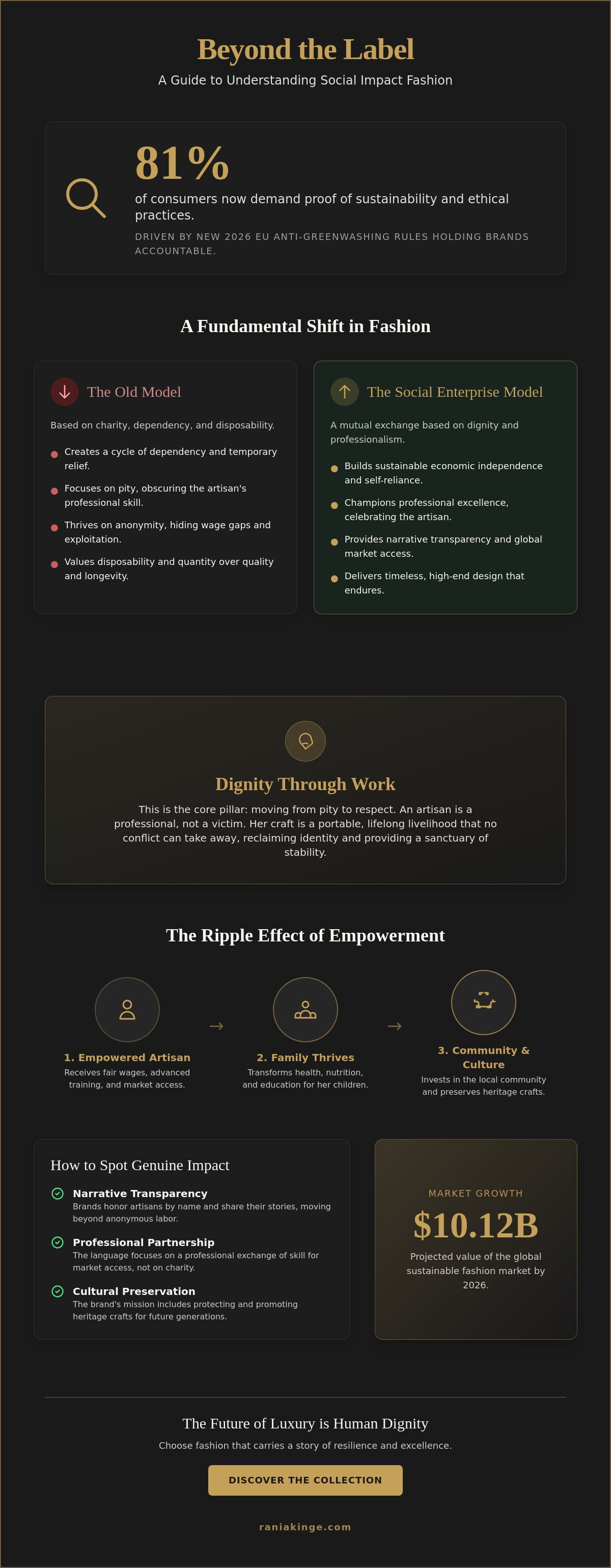
Social impact fashion is a declaration. It is a business model where human well-being and economic independence are the primary measures of success, not just the quarterly bottom line. For too long, the industry relied on the language of charity, which often creates a cycle of dependency and temporary relief. We are witnessing a fundamental shift toward the social enterprise model. This is a mutual professional exchange where the artisan provides exquisite skill and the brand provides access to the global market. The result is a piece of clothing that carries the weight of a story and the precision of high-end design.
Dignity isn't given; it is reclaimed through the mastery of a craft. When a woman in a refugee camp or a marginalized community sits down to create, she isn't a victim seeking a donation. She is a professional artisan. This "Dignity through Work" is the core pillar of the movement. It bridges the gap between raw humanitarian urgency and the refined world of luxury. By focusing on professional excellence, we move away from pity and toward respect. It's the difference between a one-time gift and a lifetime of self-reliance.
The Evolution from Fast Fashion to Conscious Design
Fast fashion thrives on anonymity and disposability. It obscures the wage gaps and unsafe conditions that have plagued the industry for decades. In contrast, conscious design focuses on the timeless. By 2026, 81% of consumers want proof of sustainability claims, according to current market research. This shift is driven by a refusal to ignore the social cost of cheap apparel. People are tired of the hidden human cost. They want pieces that tell a story of resilience rather than exploitation. They are choosing items that will last for years, not weeks, valuing quality over quantity.
Why 'Social Impact' is More Than Just a Buzzword
Impact is measured in more than just dollars. It's found in fair wages, the development of new skills, and direct community investment. Social impact fashion creates a ripple effect where one empowered woman can transform the health and education of her entire family. While environmental sustainability focuses on the planet, social sustainability focuses on the person. This intersection is the heart of fashion activism, using the clothes we wear to demand a more just world. It's about creating beauty that doesn't require someone else's suffering. By 2026, the global sustainable fashion market is valued at approximately $10.12 billion, reflecting a growing global consensus that the way we dress matters to the people who make our clothes.
The Mechanism of Empowerment: How Craftsmanship Builds Resilience
The artisan is the protagonist of her own story. She is not a passive recipient of aid; she is the beating heart of social impact fashion. While global policy discussions often focus on the social and environmental impacts of fashion at a distance, the real transformation happens at the workbench. It is here that raw materials meet centuries-old skills. For a woman who has lost her home, a needle and thread represent more than a tool. They are a bridge to a future she controls. This professional partnership restores the sense of self that displacement tries to erase. When an artisan masters a complex stitch, she isn't just earning a wage. She is reclaiming her identity.
Traditional humanitarian aid addresses immediate physical needs but can leave the spirit feeling hollow. Professional excellence does the opposite. It provides a portable, lifelong livelihood that no border or conflict can take away. This skill becomes a sanctuary of stability in an unpredictable world. The psychological impact of dignified work is profound. It moves the human subject from a place of "needing" to a place of "providing." This shift creates a foundation of resilience that supports not just the woman, but her children and her community. It is a quiet defiance against the chaos of displacement.
The Artisan Journey: From Displacement to Professionalism
The journey begins in conflict-affected regions where talent is abundant but opportunity is scarce. We identify women who possess the spark of creativity and provide them with the rigorous training needed to meet international luxury standards. We honor these women by name because their identity is as valuable as their work. Exquisite beauty can, and does, emerge from places of immense struggle. This process transforms a survivor into a professional, ensuring that the women behind the products are never overshadowed by the items themselves. It is a journey of turning raw resilience into refined craftsmanship.
Preserving Heritage as a Social Act
Heritage is a living manifesto. By adapting ancient Syrian artisanal techniques for a modern, global audience, we ensure these traditions don't vanish into history. Handcrafted items possess a soul that automation can't replicate. Each stitch is a deliberate choice, a preservation of cultural memory in an era of mass-produced automation. This preservation is vital for maintaining a sense of belonging for displaced communities. You can see this philosophy in action through our collection of ethical handbags, where every piece serves as a vessel for cultural resilience. Consider how a piece like the Siano bag carries the weight of history and the promise of a dignified tomorrow.
Social impact fashion is often misunderstood as a form of high-end donation. It isn't. A pity purchase might clear a consumer's conscience for an afternoon, but it does nothing to build a sustainable future for the woman at the loom. To truly empower, a product must compete on the global designer market based on its own merits. This is the fundamental difference between a one-way gift and a professional investment. When you choose a piece from a social enterprise, you aren't just giving money; you're participating in a professional partnership that demands uncompromising quality. Quality is the only currency that creates lasting change.
The premium paid for these items represents an investment in human capital rather than a simple donation. It covers fair wages, safe workshops, and the time required for meticulous hand-stitching that automation cannot replicate. In 2026, where 81% of consumers demand proof of sustainability and new EU regulations target greenwashing, the only way for a brand to survive is to exceed international design standards. A Dweir bag or a Gigi top must be as structurally sound and aesthetically pleasing as any item found on a Parisian runway. If the design fails, the mission fails. Sustainable impact requires a product that people want to wear for its beauty, not just its backstory.
The Professionalism of Resilience
The phrase "Made by displaced women" is often misinterpreted as a plea for help. In a true social enterprise, it is a seal of high-level skill. These women bring centuries of heritage techniques to the table, refined through rigorous quality control processes that match global luxury benchmarks. Every Patricia cardigan or Happy tunic undergoes the same scrutiny as any high-end label. This sophisticated blend of humanitarian urgency and design aesthetics ensures that the final product is a masterpiece of resilience. We don't settle for "good enough for charity"; we strive for "exquisite by any standard."
Moving Beyond the 'Pity-Based' Vocabulary
We must strip away the language of victims and replace it with the vocabulary of strength. Charity speaks of "helping the vulnerable" or "the poor." In contrast, social impact fashion speaks of "artisans" and "economic independence." This shift in tone transforms the consumer from a donor into a patron of the arts. It allows the woman behind the product to stand tall, recognized for her skill rather than her struggle. The visionary activist-designer acts as a bridge, ensuring that these stories of dignity reach the global market without losing their raw, emotional power. Skill is the foundation, and dignity is the inevitable result.
The Consumer Checklist: How to Evaluate Social Impact Claims
The marketplace is crowded with promises. As new EU anti-greenwashing regulations take effect in late 2026, the burden of proof is shifting from the consumer to the brand. However, navigating the world of conscious consumption still requires a discerning eye. You don't have to be an industry expert to distinguish between a marketing veneer and a genuine social enterprise. Authentic social impact fashion is built on a foundation of radical transparency. It moves beyond vague slogans to provide concrete evidence of how every stitch contributes to a woman's economic independence.
When evaluating a brand, look for the "human-to-product" ratio. Is the artisan the protagonist of the story, or is she an anonymous figure used to evoke pity? Genuine impact-driven labels honor the specific women behind the work. They treat their makers as professional partners, not as charitable subjects. Assess the longevity of the brand's commitment to its chosen community. A flash-in-the-pan collection for a single season rarely creates the systemic change needed for true resilience. Look for deep, multi-year partnerships that prioritize skill development and community stability over temporary trends.
Transparency and Traceability
Start with the "About Us" page. If you find vague claims about "giving back" without specific metrics or named community partners, consider it a red flag. A transparent brand will tell you exactly where their workshops are located and who is leading the production. They share the stories of the artisans by name, celebrating their individual talents. In 2026, 81% of consumers want proof of sustainability according to recent industry data. If a brand cannot or will not provide clear data on fair wages and working conditions, their impact is likely superficial. True transparency is a signature of respect for both the maker and the wearer.
Design Integrity and Timelessness
Style is a social act. A garment's longevity is directly tied to its impact; a piece that lasts for years provides more stable work for the artisan and less waste for the planet. This is why we focus on versatile, timeless designs. Pieces like the Patricia cardigan or the Happy tunic are designed to transcend seasons, moving away from the "disposable" culture of fast fashion. When you buy less but buy better, you are investing in the dignity of the person who made your clothes. You can explore our collection of handcrafted social impact fashion to see how high-end design and humanitarian urgency coexist in every thread. Choosing quality is a declaration that the hands that made your clothes deserve a future as enduring as the garment itself.
The Rania Kinge Model: Crafting a Living Manifesto
The Rania Kinge model is a living bridge. It connects the polished streets of Geneva, the humanitarian capital of the world, with the raw, unfiltered reality of marginalized communities. This isn't a static business entity. It's a movement that proves social impact fashion can be as sophisticated as any luxury label while maintaining its grassroots soul. Every piece we create acts as a vessel for a story that needs to be told, a story of dignity that refuses to be silenced by displacement or conflict. We don't just sell a product; we advocate for a cause, making the brand feel like a living, breathing testament to the transformative power of creativity.
The Dweir bag and Siano bag are more than accessories. They are embodiments of resilience, handcrafted with a level of precision that challenges the very definition of modern luxury. These bags carry the weight of tradition and the sharp edge of contemporary design. Similarly, the Gigi series, including the Gigi top and Gigi shorts, represents a fusion of modern silhouettes and ethical production. They prove that conscious apparel doesn't have to sacrifice a high-end aesthetic. For those seeking a blend of comfort and conscience, the Patricia cardigan and Happy tunic offer a tactile reminder that what we wear can be a powerful tool for social change.
A Geneva-Based Vision for Global Change
The brand's roots in Geneva are intentional. Being at the heart of international cooperation allows us to act as a visionary bridge, bringing the skills of artisans in conflict-affected regions to a global audience. The founder's role as an activist-designer is deeply grounded in the grassroots reality of the workshops. This isn't leadership from a distance. It's a commitment to being present where the work happens, ensuring that every Patricia cardigan or Happy tunic meets a standard of professional excellence that honors the maker. We operate as a living manifesto, advocating for a world where beauty is never decoupled from justice.
Your Purchase as a Statement of Solidarity
When you choose a piece from this collection, you're doing more than buying a garment. You're making a statement of solidarity. Your purchase has a direct impact on an artisan's life, providing the economic independence she needs to rebuild her future. It's an invitation to become part of a larger story, one where the human subject is never overshadowed by the product. We invite you to Explore the collection and support social impact fashion. By choosing pieces "Crafted with resilience," you aren't just wearing a design; you're wearing a testament to the enduring strength of the human spirit.
The Future of Luxury is Human Dignity
We've explored how social impact fashion is far more than a passing trend; it's a professional partnership that restores what displacement tries to take away. By shifting our focus from pity toward professional excellence, we recognize that the true value of a garment lies in the skill of the hands that made it. Quality is not just a standard. It is a tool for resilience. When the artisan is the protagonist of her own story, every piece becomes a living manifesto of her strength and economic independence.
Since 2014, our dedicated social enterprise has acted as a bridge between Geneva-based design and the raw talent of artisans in conflict-affected regions. We focus on directly empowering displaced women through professional craftsmanship, ensuring their heritage techniques are preserved for a global market. Every stitch in a Siano bag or a Gigi top is a declaration of dignity. We invite you to Discover Exquisite Fashion Crafted with Resilience and join a movement where beauty and justice are inseparable. Your choice to buy better is a powerful act of solidarity that echoes far beyond your wardrobe.
Frequently Asked Questions
What is the difference between ethical fashion and social impact fashion?
Ethical fashion is a broad term that focuses on reducing harm through fair labor and environmental standards. Social impact fashion goes deeper by making social change the primary objective of the business model. It doesn't just seek to avoid exploitation; it actively creates economic independence and restores dignity to marginalized communities through professional partnerships.
How do I know if a fashion brand is truly a social enterprise?
A true social enterprise prioritizes human well-being over the bottom line and provides radical transparency. You should look for brands that name the specific artisans and communities they support rather than using vague slogans. Authentic labels act as a bridge, offering concrete data on how their revenue is reinvested into skill development and community resilience.
Why is social impact fashion often more expensive than fast fashion?
The price reflects the true cost of dignity and uncompromising quality. You are paying for fair wages, safe workshops, and the meticulous time required for handcrafted work that automation cannot replicate. Fast fashion relies on hidden human costs to keep prices low. Choosing social impact fashion is an investment in human capital and a garment designed to last for years.
Can social impact fashion really make a difference in conflict zones?
Work provides a sanctuary of stability in an unpredictable world. In conflict zones, professional training offers displaced women a portable livelihood that no border can take away. This shift from victim to professional creates a foundation of resilience. It supports entire families and preserves cultural heritage when traditional structures have collapsed.
How does social impact fashion empower women specifically?
Economic independence is the most powerful tool for systemic change. When a woman earns a fair wage through her skill, she gains control over her future and a voice within her community. This model replaces the cycle of dependency with a discourse of professional excellence. It ensures that the women behind the products are recognized for their strength and mastery.
What should I look for on a garment label to verify social impact?
Look for transparency that goes beyond the "Made in" tag. A label that supports social impact often mentions the specific community or the artisan who crafted the piece. While certifications like the World Fair Trade Organization (WFTO) provide a baseline, the most reliable proof is the brand's commitment to sharing the narrative of the makers throughout the entire production process.
Is social impact fashion only about handmade or artisanal goods?
Handcrafted goods are a primary focus because they preserve heritage and provide direct work, but the model isn't limited to them. Any production system that prioritizes worker ownership, fair wages, and community investment can create impact. However, the artisanal process often allows for a deeper connection between the wearer and the human resilience stitched into the fabric.
How can I support social impact fashion without buying new clothes?
You can support the movement by becoming a vocal advocate for the artisans. Share the stories of the women behind the labels and educate others on the importance of dignity in the supply chain. Supporting the resale market for ethical brands also ensures these high-quality pieces stay in use, honoring the skill and resilience of the hands that originally created them.